Passive Income Ideas for Developers in 2026 — What Actually Works
Your coding skills can generate income while you sleep. Here are the passive income streams I've personally tried, what worked, what flopped, and what I'd prioritize in 2026.
Zeeshan Zakir

Three years ago a client payment arrived while I was asleep. I remember waking up, seeing the notification, and feeling like I'd discovered something important. The money wasn't passive — I had done the work — but the timing made me wonder: what if some income actually didn't require me to be present at all?
That question sent me down a rabbit hole that took about two years to properly understand. The term "passive income" gets thrown around in ways that make it sound effortless and fast. The reality is messier and more interesting than the headlines suggest. Most passive income streams require serious upfront work. None of them work for everyone. But for developers specifically, the technical skills you already have are a real advantage in building income that scales beyond trading hours for money.
Here's what I've actually explored, what produced real results, and what I'd focus on if I was starting fresh today.
The Developer Advantage Nobody Talks About Enough
Before the ideas — let me explain why developers have an unusual edge in building passive income compared to most people.
The products that generate the most reliable passive income online are software products — apps, tools, templates, plugins, APIs. Building these requires technical skill. Most people who want to sell digital products don't have that skill and have to hire someone or learn it. You already have it.
This means the barrier that stops most people from building a SaaS product or selling code templates is a barrier that doesn't exist for you. Your challenge is different — it's not whether you can build it, it's whether you can market it. That's a learnable skill. The building part you already know.
1. Selling Code Templates and UI Kits
This is the most underrated passive income stream for frontend and full-stack developers.
Templates and UI kits are reusable starting points that other developers buy to save time. A well-designed Next.js starter template with authentication, a dashboard layout, and a Stripe integration can sell for $30–$80 per download. A Tailwind CSS component library can sell for $20–$50.
The best part is that the marginal cost of each sale is essentially zero. You build it once, list it on Gumroad or Lemon Squeezy, and every sale is income without additional work.
The tricky part is discoverability. There are a lot of templates on the market. The ones that sell consistently are either very specialized (a template specifically for SaaS admin dashboards, for example) or come with strong documentation and a clear use case.
I built a Next.js admin dashboard template and listed it for $39. In the first three months it earned $780 from 20 sales — all from organic search and one mention in a developer newsletter. Not life-changing money, but entirely passive after the initial build.
2. Affiliate Income from Developer Tools
If you write about developer tools, the affiliate programs for hosting and SaaS tools are some of the best-paying in the industry.
Hostinger affiliates pay $60–$150 per converted sale. DigitalOcean has an affiliate program. Many SaaS tools offer 20–30% recurring commissions — meaning you earn every month a referred customer remains subscribed.
The key to making this work is genuine recommendation. Developers can tell when someone is recommending a tool they've never used just to earn a commission. Write honestly about tools you actually use, explain specifically what makes them useful for your workflow, and the affiliate income follows naturally.
This blog — codewithlogs.com — is being built with exactly this model. The tools page recommends platforms I genuinely use. The affiliate income is real but secondary to the value I'm trying to provide.
3. Building a Micro-SaaS
A micro-SaaS is a small, focused software product that solves one specific problem and charges a monthly subscription.
The classic examples are things like a PDF conversion tool, a social media scheduling app, an invoice generator, a simple analytics dashboard, or a waiting-list tool. Small, unglamorous, solves a specific pain, charges $5–$29/month.
The income potential is real. 50 customers at $15/month is $750/month recurring. 200 customers at $10/month is $2,000/month. The products that reach those numbers aren't always technically impressive — they're just useful and reliable.
The challenge is building something people actually need rather than something you find technically interesting. The best micro-SaaS ideas come from problems you encounter in your own work or things you've heard clients complain about repeatedly.
The tech stack for micro-SaaS is straightforward for a MERN developer. Next.js for the frontend, MongoDB or Postgres for data, Stripe for billing, Vercel for hosting. You can have an MVP running in a weekend.
4. Creating Online Courses or Tutorials
The online education market for developers is large and growing. A course on Udemy about a specific technical topic — how to build a REST API with Node.js, how to use MongoDB Atlas, how to deploy Next.js to Vercel — can sell thousands of copies at $15–$20 each when Udemy runs their frequent promotions.
Creating a course is a significant upfront time investment. Recording, editing, structuring, and uploading a 4–6 hour course might take 50–80 hours of work. But a good course can sell for years with minimal maintenance.
The topics that sell well on Udemy are not always the flashiest ones. "Build a complete MERN stack app from scratch" consistently outsells "advanced React performance optimization" because the audience is larger. Aim at beginners and intermediate developers rather than seniors.
YouTube is a related option. Revenue from ad-supported YouTube content is technically passive (money arrives without you doing additional work after upload) but the volume required to earn meaningful income is significant. Most developer YouTubers treat it as a long-term brand-building exercise rather than a direct income stream.
5. Writing Technical Content for Other Blogs and Publications
Several platforms pay developers to write tutorials. freeCodeCamp pays $500 per published article for high-quality technical tutorials. CSS-Tricks (now part of DigitalOcean) has paid guest contributors. Smashing Magazine pays for frontend content. LogRocket Blog pays for React and Node.js tutorials.
This isn't strictly passive since writing takes time, but a tutorial that goes live on freeCodeCamp can drive traffic and readers back to your site for years. The combination of a one-time payment plus ongoing traffic benefit makes this one of the highest-return content strategies for developers.
6. Selling APIs as a Service
If you've built something interesting that others might want to consume, you can expose it as a paid API.
This is less common than the other ideas but has interesting potential. A developer who built a smart address validation tool, a text summarization endpoint, a custom data scraping service, or a specialized image processing API could charge a small monthly fee or per-call pricing through a platform like RapidAPI.
The market for developer APIs is significant because buyers are also developers who understand API pricing models. $0.001 per call sounds trivial but 10 million calls per month is $10,000.
7. Sponsorships on a Developer Blog or Newsletter
Once your blog or newsletter has a meaningful audience — typically 5,000+ monthly readers — developer tool companies will pay for sponsorships.
Sponsorships in the developer tools space typically run $200–$1,500 for a dedicated mention or newsletter feature, depending on audience size and engagement. Companies like Vercel, Supabase, Neon, Sentry, and many others have active developer marketing programs that include newsletter and blog sponsorships.
The income is not passive in the sense of zero work — you have to maintain the audience — but it scales without proportional effort increase. A newsletter with 20,000 subscribers earns roughly the same per-hour of writing as one with 2,000 subscribers.
What I Would Focus On Starting Today
If I was starting from scratch with the goal of passive income from my development skills, I would prioritize in this order: write a developer blog with affiliate links first (lowest upfront investment, compounds over time), build and list one code template on Gumroad second, and then start building a micro-SaaS third once I have validated audience feedback on what problems people actually want solved.
The common thread is that each step builds something durable rather than trading time for a single payment. The work compounds instead of resetting.
Need help building this?
I offer full-stack development services for startups and product teams.
If you want a faster path from idea to shipped product, I can help with architecture, frontend systems, backend APIs, and launch-ready builds.
View ServicesShare this post
Related posts
More practical reading from the blog to keep your momentum going.
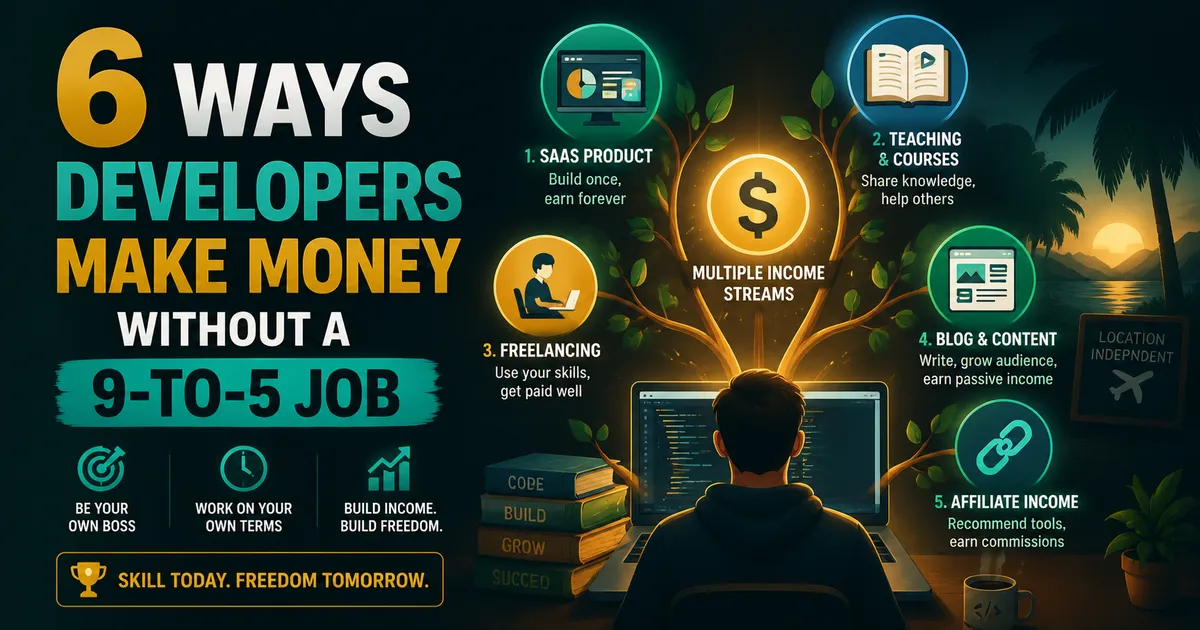
How to Make Money as a Developer Without a Traditional Job in 2026
The traditional developer career path is one option, not the only one. Here are six real paths that let you earn from your coding skills without a full-time employer.

How to Get Your First Freelance Client as a Web Developer (What Actually Worked)
Landing a first freelance client felt impossible until I stopped doing the things everyone recommends and started doing the thing that actually works.
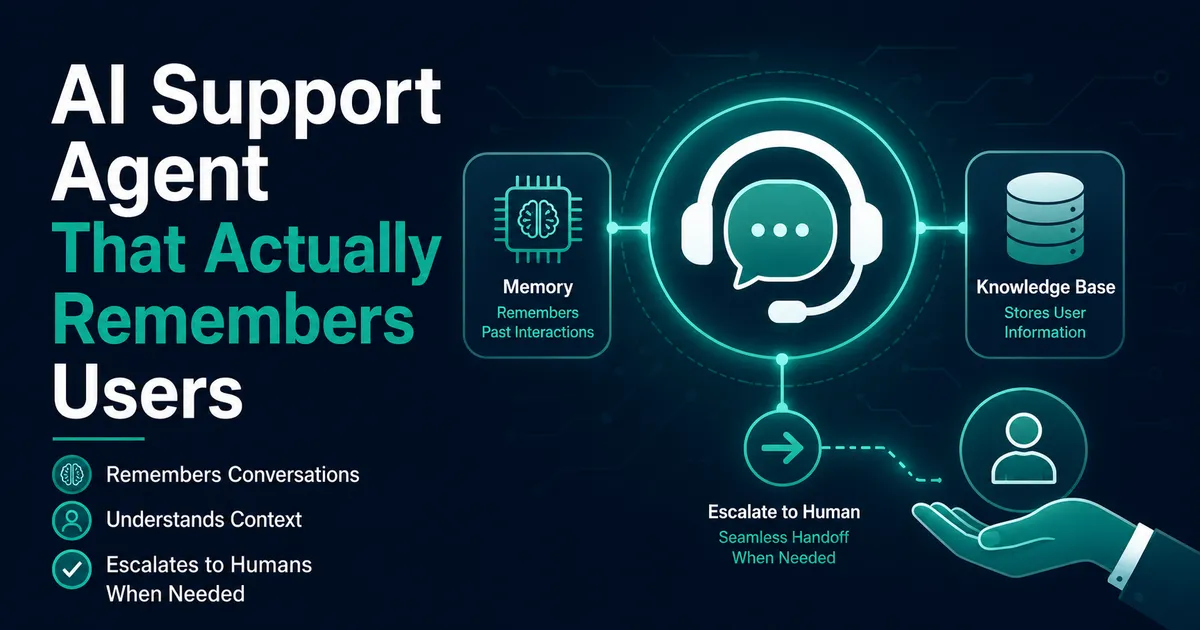
Building an AI Customer Support Agent with Memory
I built an AI customer support agent that remembers users — short-term history, long-term facts, and knowing when to hand off to a human.