
Can AI Replace Programmers? An Honest Answer From Someone Who Codes With AI Every Day
Will AI replace programmers? The honest answer isn't yes or no. After coding with AI daily, here's what it genuinely does, what it can't, and how the job is actually changing.
Zeeshan Zakir
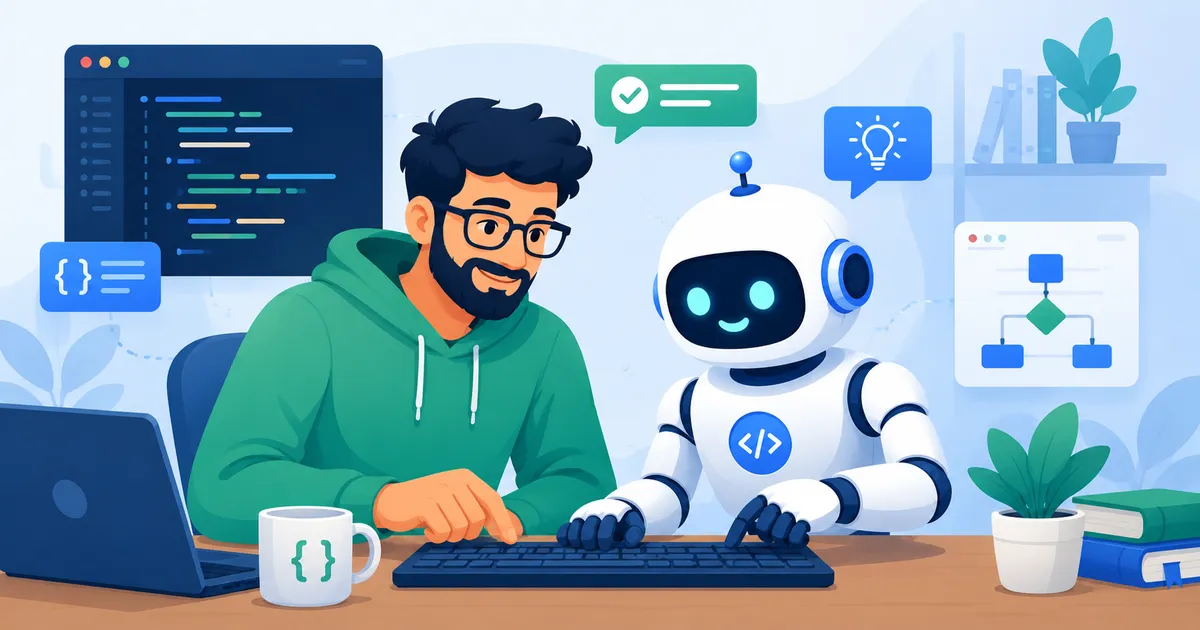
A junior developer messaged me recently, genuinely worried: "Is it even worth learning to code anymore?" It's the most common question I get now, and I understand the fear. AI writes code that runs. Headlines say programmers are obsolete. Some companies brag that AI writes a big chunk of their code.
So let me give the honest answer, because I code with these tools daily and the reality is more interesting than either the doom or the hype.
The short answer
No, AI is not replacing programmers in 2026. But it is replacing parts of the job, and that distinction is everything. The people most at risk aren't programmers in general, they're programmers who only do the parts AI is now good at and refuse to adapt.
What AI is genuinely good at
I'll be the first to say these tools are remarkable. In my own work, AI handles:
- Boilerplate and setup – the repetitive scaffolding every project needs.
- First drafts of functions – describe it, get a working starting point.
- Explaining unfamiliar code – paste a confusing block, get a plain-English breakdown.
- Writing tests – tedious work it does quickly and reasonably well.
- Translating between languages – "rewrite this Python in JavaScript" mostly just works.
- Debugging help – paste an error, get plausible causes fast.
Industry surveys back this up: a large majority of developers now use AI assistants regularly, and at some companies AI writes a meaningful share of production code. That's real, and it's why a developer with AI is dramatically faster than one without.
What AI still can't do
Here's the part the "programming is dead" crowd skips. AI struggles with everything that isn't writing a chunk of code:
- Understanding what to build. Most of real engineering is figuring out what the business actually needs, often from vague, contradictory requirements. AI can't sit in the messy meeting and translate "make it pop" into a spec.
- System design. Deciding how the pieces fit together at scale, what to optimize, what trade-offs to accept, is judgment AI doesn't reliably have.
- Debugging the hard stuff. AI is great at obvious errors and useless at the subtle, system-wide bug that only appears under specific conditions.
- Taking responsibility. When the code fails at 2 a.m. and customers are affected, a human owns that. AI can't be accountable.
- Knowing when it's wrong. This is the big one. AI is confidently incorrect on a regular basis, and you need someone who can tell the difference.
I think of current AI as an incredibly fast, tireless junior developer who has read everything but understood nothing deeply, and who never says "I'm not sure." That last trait is exactly why it can't run unsupervised.
How the job is actually changing
This is the useful framing. Programming isn't disappearing; it's shifting:
- From writing code to reviewing and directing it. More of the work is describing what you want and judging what the AI produced.
- From memorizing syntax to understanding systems. The value moves up the stack toward architecture and judgment.
- From solo typing to collaboration with a tool. The best developers I know treat AI like a pairing partner, not a replacement.
- Higher expectations. When AI handles the easy 80%, your value is in the hard 20%, the part that needs real understanding.
The uncomfortable truth: the floor is rising. Tasks that used to be a junior's whole job are now automated, which means juniors have to climb to judgment faster than before.
So should you still learn to code?
Yes, but learn it differently. Don't learn to be a human autocomplete; AI already won that. Learn to:
- Understand systems, not just syntax.
- Read code critically and spot when something's wrong.
- Solve problems and translate fuzzy needs into clear requirements.
- Use AI tools well, because the developer who directs AI skillfully outpaces the one who refuses to.
The fundamentals matter more now, not less, because you can't supervise something you don't understand.
Common mistakes people make about this topic
- Believing the extremes. Neither "AI replaces all coders" nor "AI is useless" is true. The reality is a productivity shift.
- Avoiding AI tools out of pride. Refusing to use them just makes you slower than peers who do.
- Trusting AI code blindly. Shipping unreviewed AI output is how subtle bugs and security holes get into production.
- Learning only to copy AI. If your only skill is what AI already does, that's the risky position.
- Panicking and quitting. The demand for people who understand software hasn't gone away; it's gotten more selective.
Expert tips
- Treat AI as a junior teammate. Direct it, review it, never trust it unsupervised.
- Double down on fundamentals. Systems thinking and debugging are your moat.
- Get fast at reading code, not just writing it; that's where the job is moving.
- Specialize in the hard parts, architecture, complex debugging, domain knowledge, the things AI can't do.
- Stay adaptable. The tools will keep changing; the ability to learn is the durable skill.
Need help building this?
I offer full-stack development services for startups and product teams.
If you want a faster path from idea to shipped product, I can help with architecture, frontend systems, backend APIs, and launch-ready builds.
View ServicesShare this post
Related posts
More practical reading from the blog to keep your momentum going.
What Is an API? The Waiter Analogy That Finally Made It Click for Me
APIs run almost everything you do online, but the explanations are usually awful. Here's the simple analogy that finally made it click for me, plus how APIs work and real examples you already use.
AI Memory Systems: Short-Term vs Long-Term Memory
Every API call meets a total stranger — LLMs remember nothing. How AI memory systems actually work: short-term, long-term, and forgetting.
Vector Databases Explained with Supabase pgvector
I almost paid for a dedicated vector database. Turns out Postgres does it. A practical pgvector tutorial with Supabase — setup to indexes.