Cloud Computing Explained: What It Actually Is (Without the Buzzwords)
"The cloud" sounds mysterious but it's surprisingly simple. Here's cloud computing explained in plain English, what it is, how it works, the types, the big providers, and where it genuinely helps.
Zeeshan Zakir
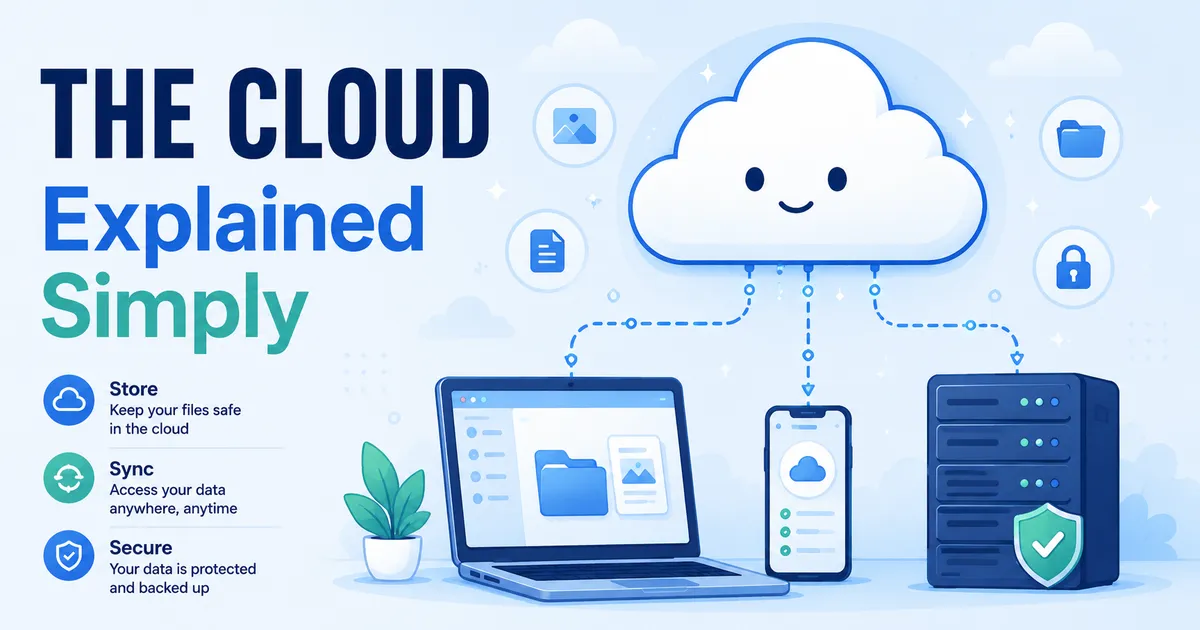
For years I nodded along whenever someone said "we're moving to the cloud," secretly unsure what that actually meant. Was the cloud a place? A product? Magic? Then a mentor explained it in one sentence and the mystery evaporated: the cloud is just someone else's computers that you rent over the internet.
That's genuinely the core of it. Everything else is detail. Let me give you those details in plain English, because once it clicks, a huge chunk of modern tech stops being intimidating.
What is cloud computing?
Cloud computing means using computing resources, servers, storage, software, processing power, that are owned and run by someone else and accessed over the internet, instead of buying and maintaining your own. You pay for what you use, like electricity, rather than building your own power plant.
When you stream a movie on Netflix, store photos in Google Photos, or use Gmail, you're using the cloud. The files and software don't live on your device; they live in massive data centers somewhere, and you reach them over the internet.
How does cloud computing work?
Companies like Amazon, Microsoft, and Google build enormous data centers, warehouses full of thousands of computers. They make that computing power available over the internet and rent it out, in slices, to anyone who needs it.
So instead of a business buying ten servers, hiring people to maintain them, and hoping they bought the right amount, they rent exactly what they need from a provider. Need more power for a busy week? Rent more. Need less next month? Scale down and stop paying for it. The provider handles the hardware, the maintenance, the cooling, the security of the building, all the parts you used to have to do yourself.
A simple analogy
Think of computing power like transportation:
- Owning your own servers is like buying a car: big upfront cost, you maintain it, and it sits idle most of the day.
- Cloud computing is like ride-sharing: you summon exactly what you need, only pay while you use it, and someone else handles the maintenance and parking.
For most needs, renting on demand beats owning, which is why the cloud took over.
The three main types of cloud services
You'll hear three acronyms constantly. Here's what they actually mean, using a pizza analogy:
- IaaS (Infrastructure as a Service) – they give you the raw ingredients (servers, storage, networking) and you build everything yourself. Most control, most work. Examples: AWS EC2, Google Compute Engine.
- PaaS (Platform as a Service) – they give you the kitchen and tools, you just bring your recipe (your code). Less control, less hassle. Examples: Heroku, Google App Engine.
- SaaS (Software as a Service) – they hand you the finished pizza; you just eat. You use ready-made software over the internet. Examples: Gmail, Salesforce, Dropbox.
Most people use SaaS every day without thinking about it. Developers and businesses choose between the three based on how much they want to control versus how much they want handled for them.
The big cloud providers
Three companies dominate:
| Provider | Known as | Strength |
|---|---|---|
| Amazon Web Services (AWS) | The market leader | Largest, most services, mature |
| Microsoft Azure | The enterprise favorite | Integrates with Microsoft tools |
| Google Cloud (GCP) | The data/AI specialist | Strong in data, analytics, AI |
There are others, but if you hear "cloud provider," it's almost always one of these three.
Why cloud computing matters
The benefits are why nearly every modern company relies on it:
- No big upfront cost. Rent instead of buying expensive hardware.
- Scales instantly. Handle a traffic spike, then scale back down, paying only for what you use.
- Access anywhere. Your files and apps follow you across devices and locations.
- Someone else handles maintenance. No managing physical servers, cooling, or hardware failures.
- Reliability. Big providers run multiple data centers, so one failure doesn't take you down.
- It powers modern AI. Training and running large AI models needs massive computing power, which the cloud provides on demand.
The drawbacks (because there always are some)
- Ongoing cost. Renting forever can eventually cost more than owning, and bills can balloon if you're not careful.
- You depend on your provider. If their service goes down, so do you. Outages, while rare, are very public.
- Vendor lock-in. Moving everything from one provider to another is genuinely hard once you're deep in.
- Less direct control. Your data sits on someone else's hardware, which raises privacy and compliance questions for some businesses.
- Needs internet. No connection, no access.
Common mistakes beginners make
- Thinking "the cloud" is one thing. It's a huge range of services, from storage to AI. "Using the cloud" can mean wildly different things.
- Ignoring the bill. Cloud costs are easy to start and easy to let spiral. Set budgets and alerts.
- Over-provisioning. Renting far more than you need, the whole point is matching usage.
- Assuming it's automatically secure. Providers secure the building; you're still responsible for configuring your part correctly. Misconfiguration causes most cloud breaches.
- Getting locked in without planning. Build with portability in mind if you can.
Expert tips
- Start small and scale up, rather than renting big "just in case."
- Set billing alerts from day one. Surprise cloud bills are a rite of passage you can skip.
- Understand the shared responsibility model: the provider secures the infrastructure, you secure how you use it.
- Learn the basics of one provider (AWS is the common starting point) if you want a tech career; cloud skills are in heavy demand.
- Match the service type to your needs: SaaS to just use software, PaaS to build without managing servers, IaaS for full control.
Need help building this?
I offer full-stack development services for startups and product teams.
If you want a faster path from idea to shipped product, I can help with architecture, frontend systems, backend APIs, and launch-ready builds.
View ServicesShare this post
Related posts
More practical reading from the blog to keep your momentum going.
AI Memory Systems: Short-Term vs Long-Term Memory
Every API call meets a total stranger — LLMs remember nothing. How AI memory systems actually work: short-term, long-term, and forgetting.
Vector Databases Explained with Supabase pgvector
I almost paid for a dedicated vector database. Turns out Postgres does it. A practical pgvector tutorial with Supabase — setup to indexes.
How I Added AI Search to My Next.js Website
Users searched "remove account," my docs said "delete account," search returned nothing. So I added AI semantic search to my Next.js site.