
RAG vs Fine-Tuning: Which One Should You Choose?
Everyone says "train the AI on our docs." I tested RAG vs fine-tuning on a real project — here's which one to choose and when.
Zeeshan Zakir
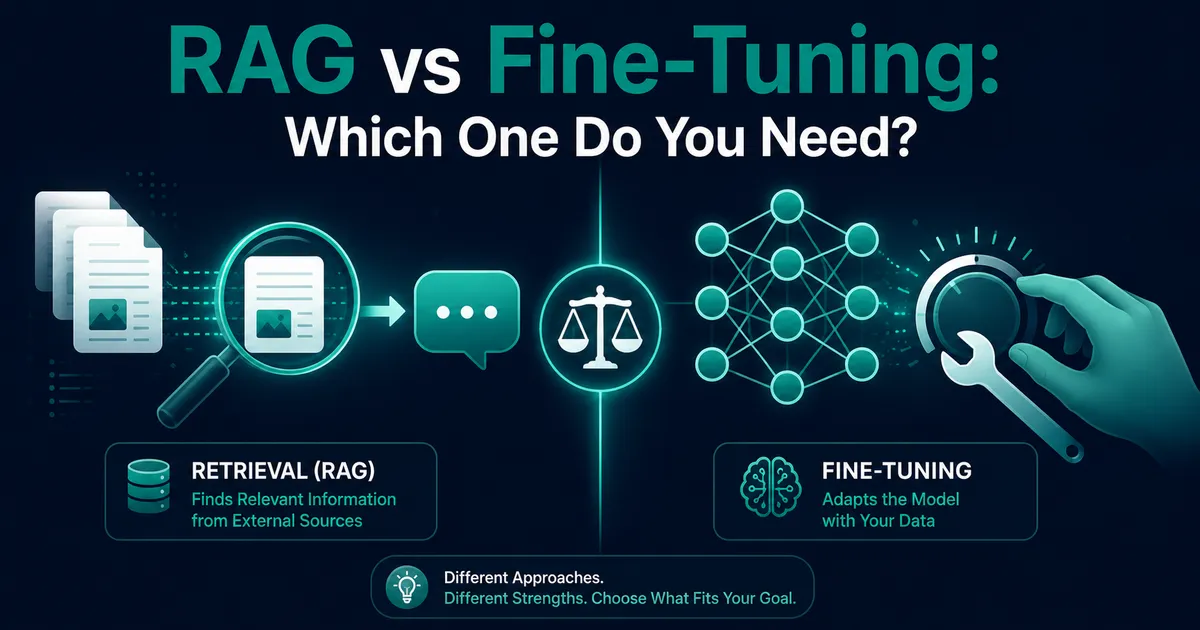
Every AI project conversation I've had with a client eventually arrives at the same sentence, delivered with the same confidence: "We'll just train the AI on our documentation."
It sounds obviously right. It's usually the wrong plan. And the reason the RAG vs fine tuning question confuses everyone is that both get described as "teaching the AI your stuff" when they do completely different things. I learned the difference the expensive way — by actually building both for the same project — so let me save you that bill.
What each one actually does
Fine-tuning continues training a model on your examples. It changes the model's behavior — tone, format, style, how it responds. Think of it as teaching habits.
RAG (Retrieval-Augmented Generation) doesn't touch the model at all. At question time, you search your documents for relevant chunks and paste them into the prompt with the question. Think of it as an open-book exam.
The one-line version I now use with clients: fine-tuning teaches the model how to speak; RAG hands it what to say. Facts live in RAG. Habits live in fine-tuning. Most "train it on our docs" requests are secretly asking for facts — which means they're asking for RAG without knowing it.
The experiment that settled it for me
The project: a support assistant for a SaaS with a few hundred pages of docs (the same system from my AI support agent build). I built both versions.
The fine-tuned version: I generated Q&A pairs from the docs and fine-tuned a small model on them. Cost real money and a day of dataset wrangling. The result sounded fantastic — perfectly on-brand tone. And then it started answering questions about features with details that didn't exist. Worse: when we updated a pricing detail in the docs, the model kept serving the old answer, because that answer was baked into its weights. To fix it: rebuild the dataset, retrain, redeploy. For every doc change. Forever.
The RAG version: docs chunked, embedded, stored in Postgres with pgvector, retrieved by similarity at question time. When the pricing page changed, I re-embedded one page and the next answer was correct. And every answer could cite which doc it came from — which, for a support tool, turned out to matter more than tone. "According to the billing docs..." builds trust that a beautifully phrased hallucination destroys.
The verdict wasn't close. For knowledge, retrieval won on freshness, on verifiability, and on total cost of ownership.
The honest comparison table
| Factor | RAG | Fine-Tuning |
|---|---|---|
| Adding new knowledge | Update documents, done | Retrain the model |
| Stale information risk | Low — reads current docs | High — frozen at training time |
| Can cite sources | Yes, naturally | No |
| Controls tone/format | Weakly (via prompt) | Strongly |
| Upfront effort | Moderate (pipeline setup) | High (dataset quality is everything) |
| Per-request cost | Higher (context tokens) | Lower (short prompts) |
| Hallucinating facts | Reduced, not eliminated | Confidently frequent on unseen facts |
That per-request line deserves honesty: RAG pushes retrieved chunks into every prompt, so you pay for those tokens on every call. Fine-tuning's short prompts are cheaper per request. If you have massive volume and a stable knowledge base, that math can matter — it just rarely beats the cost of maintaining retraining pipelines.
Where fine-tuning genuinely won for me
I don't want to strawman fine-tuning, because one of my projects is a clear win for it: a classifier that reads incoming messages and outputs a strict JSON verdict — category, urgency, sentiment. No knowledge required, just extremely consistent behavior at high volume.
Prompting a large model to do this worked but was slow and pricey at scale. Fine-tuning a small, cheap model on a few thousand labeled examples made it faster, dramatically cheaper per call, and more consistent in output format than the big model ever was. Facts change; the shape of that task never does. That's the fine-tuning sweet spot: stable behavior, high volume, zero knowledge freshness requirements.
The decision framework I actually use
Ask one question first: "When your information changes, should the answers change?"
- Yes → RAG. No exceptions I've found.
- The problem is tone, format, or task behavior, not information → fine-tuning.
- Both ("answer from our docs, in our exact style") → RAG first, always. Get correctness working. A good system prompt covers 90% of style. Only if the remaining 10% provably matters do you add fine-tuning on top of RAG — they stack fine.
And the option nobody sells because it's free: for small knowledge bases, skip both. Context windows are large now; if your docs fit comfortably in the prompt, just include them (prompt caching makes this shockingly cheap — that's the next article). I've replaced a planned RAG pipeline with "paste the docs" more than once, and it embarrasses me how well it works.
What I tell clients now
When "train it on our docs" comes up, I translate: you want the AI to answer from your docs, stay current when they change, and show its sources. Everyone nods. That's RAG — the training they imagined was never the thing they needed. Start there, measure what's actually wrong with the answers, and let fine-tuning earn its way in only for the problems retrieval can't fix. In my projects so far, that's been exactly one problem out of every ten.
Need help building this?
I offer full-stack development services for startups and product teams.
If you want a faster path from idea to shipped product, I can help with architecture, frontend systems, backend APIs, and launch-ready builds.
View ServicesShare this post
Related posts
More practical reading from the blog to keep your momentum going.
AI Memory Systems: Short-Term vs Long-Term Memory
Every API call meets a total stranger — LLMs remember nothing. How AI memory systems actually work: short-term, long-term, and forgetting.
Vector Databases Explained with Supabase pgvector
I almost paid for a dedicated vector database. Turns out Postgres does it. A practical pgvector tutorial with Supabase — setup to indexes.
How I Added AI Search to My Next.js Website
Users searched "remove account," my docs said "delete account," search returned nothing. So I added AI semantic search to my Next.js site.