On this page
Table of Contents
The question I get asked more than any other from developers who are new to frontend frameworks is some version of: which one should I learn?
And for years the answer was simple — learn React. It dominates the job market, has the largest ecosystem, and every tutorial you need exists already.
But the landscape in 2026 is more interesting than that. Vue has matured significantly. Svelte has built a passionate following. New frameworks like SolidJS and Qwik are pushing boundaries. The React dominance is still real but no longer unquestioned.
I've used all three seriously enough to have opinions worth sharing. Not benchmarks and performance comparisons — you can find those anywhere. What I want to share is what it actually feels like to build something with each one.
React — The Industry Standard
React is a JavaScript library (not technically a full framework, though it's used like one) created by Facebook and open-sourced in 2013. It introduced component-based UI development to mainstream web development and permanently changed how frontends are built.
In 2026 React still has the largest job market share of any frontend framework by a significant margin. Most large companies building web applications use React. Most startups default to React. Most tutorials default to React.
What it's actually like to use: React's core concept is simple — components are functions that return JSX, which is HTML-like syntax in your JavaScript. State management with useState and side effects with useEffect are the two hooks you'll use in 80% of components.
The part that trips beginners up is that React is a library, not a framework. It handles rendering. Everything else — routing, state management, data fetching, form handling — requires additional decisions. React Router for routing. Redux, Zustand, or Jotai for global state. React Query for server state. This flexibility is powerful for experienced developers and genuinely confusing for beginners who just want things to work.
Next.js changes this significantly. When you use Next.js (which is a framework built on top of React), most of these decisions are made for you. Next.js is what most React development looks like in practice in 2026, and it provides the full framework experience that plain React lacks.
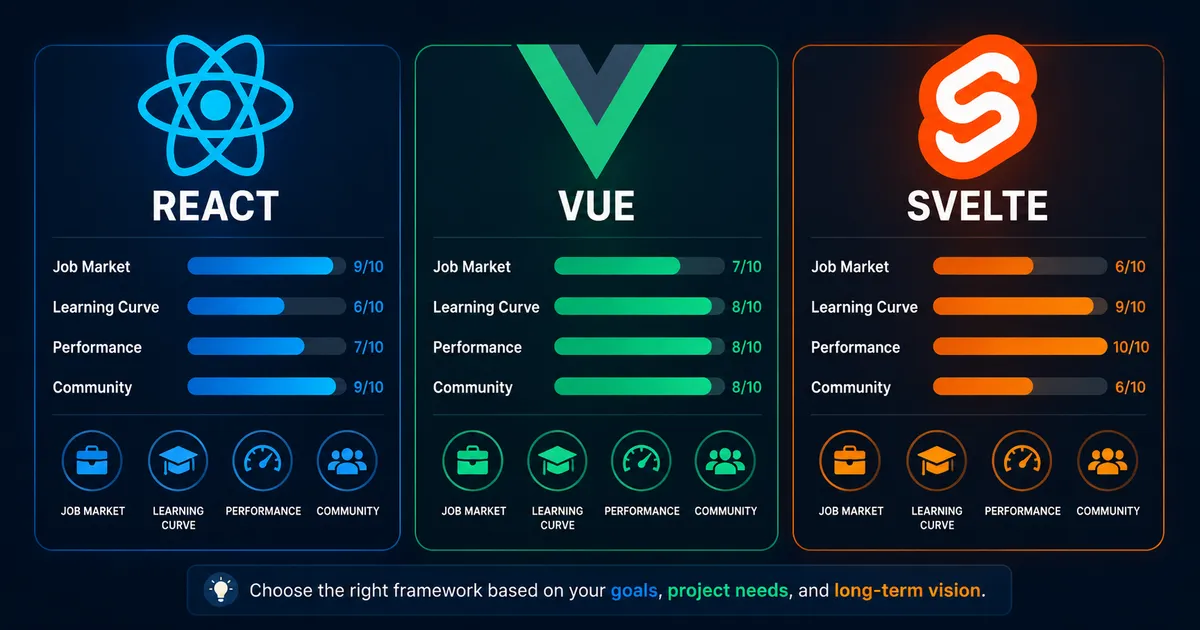
Job market: Strongest by a wide margin. If you want to maximize your employability as a frontend developer, React is still the clear answer.
Learning curve: Moderate. The concepts are learnable but the ecosystem decisions create significant initial confusion.
Vue — The Friendly Alternative
Vue.js was created by Evan You, a former Google engineer, and first released in 2014. It was designed to be easier to pick up than React while being more structured and opinionated.
Vue 3 with the Composition API (the current modern approach) is a mature, well-designed framework that I genuinely enjoy using. The template syntax feels natural to anyone who's written HTML and JavaScript, the reactivity system is intuitive, and the official documentation is the best in the frontend framework world.
What it's actually like to use: Vue components feel more self-contained and organized than React components by default. You have a <template> block for HTML, a <script> block for logic, and a <style> block for CSS — all in one file with clear separation.
Vue's reactivity system using ref() and reactive() is cleaner to reason about than React's useState for many developers. When a value changes, Vue tracks the dependencies automatically and updates only the affected parts of the UI.
The ecosystem is smaller than React's but sufficient for most applications. Nuxt.js is the Vue equivalent of Next.js and provides the same kind of full-stack framework experience.
Job market: Significantly smaller than React but not negligible. Vue is particularly popular in Asia (especially China), in European companies, and in projects where teams value developer experience and code readability.
Learning curve: Lower than React. The template syntax is familiar, the documentation is excellent, and the mental model is consistent.
Svelte — The New Paradigm
Svelte is genuinely different from both React and Vue in a fundamental way. React and Vue do their work in the browser — they ship a runtime library that your components use to update the DOM. Svelte shifts this work to compile time — it compiles your components into vanilla JavaScript during the build step, resulting in no framework runtime in the browser.
What it's actually like to use: Svelte code is the most readable and concise of the three. Variables declared with let are automatically reactive. No useState, no useEffect, no .value wrappers. You write closer to plain JavaScript and HTML than either React or Vue.
<script>
  let count = 0

  function increment() {
    count++
  }
</script>

<button on:click={increment}>
  Count: {count}
</button>
That's a complete reactive counter component in Svelte. The equivalent in React requires importing useState, creating a state variable, and creating a setter function. Svelte's approach is just more direct.
The tradeoffs: Svelte's ecosystem is smaller. Fewer pre-built components, fewer libraries built specifically for it, fewer tutorials. SvelteKit (the full-stack framework equivalent of Next.js for Svelte) is excellent but younger and less battle-tested.
Job market: Currently much smaller than React. Most companies that use Svelte are either early adopters or smaller teams that prioritize developer experience. This is changing but slowly.
Learning curve: Lowest of the three. The syntax is the most intuitive. The reactivity model is the easiest to understand.
My Honest Recommendation
If you want the most job opportunities, learn React with Next.js. The gap between React and everything else in the job market is still substantial. If you're learning to increase your employability or transition into a professional developer role, React is the pragmatic choice.
If you want the best developer experience and you're building your own projects without being constrained by employer expectations, try Svelte or Vue. Both have genuine advantages in code clarity and initial learning speed.
If you're already a comfortable React developer wondering whether to learn another framework — learn Vue for the perspective it gives you on frontend architecture, or try Svelte for a weekend project to experience a genuinely different approach.
The worst decision is paralysis. Any of these three frameworks will teach you component-based UI development, which transfers between them more easily than the learning curve suggests. Pick one and build something real with it.
Keep the conversation useful
Found a different result?
Include your framework version, the error, and the steps to reproduce it. Specific details help improve the article for the next reader.
Send a correction or question