
What Are AI Agents and How Do They Actually Work (Plain English Guide)
AI agents are everywhere in 2026 but most explanations make them sound more complicated than they are. Here's a plain-English breakdown of what they actually do.
Zeeshan Zakir
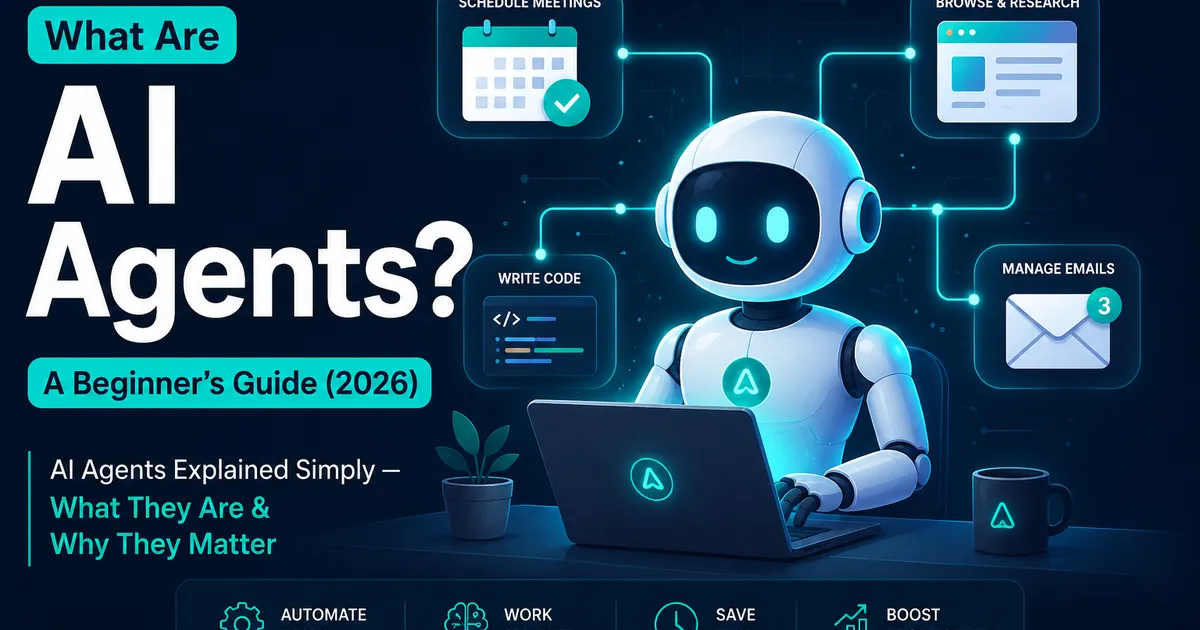
Last year I asked ChatGPT to help me draft an email. I typed the request, it gave me a draft, I copied it, switched to Gmail, pasted it, edited the subject line, and sent it. Four app switches. Two minutes. That felt efficient at the time.
Then I watched a demo of an AI agent doing the same task. It received the instruction, opened Gmail by itself, drafted the email in the compose window, waited for my approval, and sent it. I didn't touch anything. That demo changed how I think about what AI is actually becoming.
AI agents are the next phase. Not just AI that responds to questions — AI that takes actions.
The Simplest Way to Understand an AI Agent
Think about the difference between a calculator and a personal assistant.
A calculator waits for you to type numbers, does the math, and shows you the result. It does exactly one thing per instruction and then stops.
A personal assistant can take a goal — "plan my trip to New York next month" — and figure out all the steps themselves. They search for flights, check your calendar, book a hotel, add reminders, and update your itinerary. You gave them one instruction and they executed a chain of tasks.
That's roughly the difference between a standard AI chatbot and an AI agent. The chatbot responds. The agent acts.
What Actually Makes Something an AI Agent
An AI agent has four core properties that distinguish it from a regular AI tool.
It has a goal. Not just a single question to answer, but an objective to accomplish over multiple steps.
It can take actions. It can browse the web, run code, send messages, read files, call APIs, or interact with software interfaces.
It can observe results. After each action it checks what happened and decides what to do next based on that feedback.
It operates with some autonomy. It doesn't ask for permission at every step. It reasons through the problem and acts.
Put those four things together and you have a system that can work through complex multi-step tasks without holding your hand through every decision.
A Real Example: How an AI Agent Handles a Coding Task
Let me make this concrete with something relevant to developers.
Say you give an AI agent this instruction: "Find the bug in my authentication code that's causing login failures in production."
A regular AI chatbot would need you to paste the code, describe the problem, and give it all the context. Then it answers and stops.
An AI agent would approach it differently. It reads your codebase itself. It looks at recent error logs in your deployment dashboard. It checks git history for recent changes to the auth files. It cross-references the error messages with the code. It identifies the likely cause. Then it either proposes a fix or actually edits the file, depending on what permissions it has.
You gave it one sentence. It did the investigation. That's what makes agents genuinely useful for complex work.
The Tools Building AI Agents Right Now
Several platforms are making it easier to build or use AI agents in 2026, and some are already accessible to beginners.
Claude (Anthropic) has been building toward agentic behavior for a while. The model is good at multi-step reasoning and is used in many agent frameworks.
ChatGPT with tools can browse the web, run Python, and interact with connected apps — a simple form of agentic behavior that many people use without calling it an agent.
Cursor's agent mode lets the AI read your entire codebase, make changes across multiple files, run tests, and fix the failures it finds. I have used this on small refactors and it genuinely impressed me.
LangChain and LlamaIndex are developer frameworks for building your own agents. They're not beginner tools, but if you want to build a custom agent that connects your company's data to an AI, these are the tools people use.
AutoGPT and similar projects were early experiments in fully autonomous agents. They were often unreliable, but they introduced millions of people to the concept and pushed the field forward.
Why AI Agents Are a Big Deal in 2026
The reason everyone is talking about agents right now is that the underlying AI models finally got good enough to make them reliable. Earlier agent experiments failed a lot — the AI would misunderstand the goal, take a wrong action, fail to recover, and spiral into useless behavior.
The models available in 2026 are much better at planning, checking their own work, and recovering from errors. Only 11% of organizations have agents in production despite 38% piloting them — which means we're right at the inflection point where agents are moving from experiment to real deployment.
For developers, this means two things. First, some of your current work will eventually be handled by agents — the repetitive parts, the boilerplate, the testing. Second, there's a real career advantage right now in understanding how agents work and how to build with them.
What AI Agents Are Not Good At (Yet)
I want to be honest about the limits because the hype can get out of hand.
AI agents still make mistakes. They sometimes misinterpret goals, take unnecessary actions, or get stuck in loops. In any task where a mistake is costly — sending a real email to a real client, deleting files, processing payments — you want human review before the agent acts.
They're also not good at tasks that require genuine judgment, emotional intelligence, or contextual understanding that isn't in any document. An agent can schedule a meeting but it can't tell whether the meeting is a good idea.
The right mental model is: AI agents are reliable for well-defined, repeatable tasks with clear success criteria. They're still unreliable for open-ended judgment calls.
How Developers Can Start Learning About Agents Today
If you want to get hands-on with agents without a deep AI background, the most practical starting point is Cursor's agent mode. It's already in a tool you're probably using, and watching it navigate a real codebase teaches you more about how agents reason than any article can.
After that, reading the documentation for LangChain gives you a good conceptual map of how agents are built programmatically — even if you don't build anything with it immediately.
The most important thing to understand is the loop: perceive, plan, act, observe. That four-step cycle is how every agent operates, and once you internalize it, the rest of the field makes a lot more sense.
Need help building this?
I offer full-stack development services for startups and product teams.
If you want a faster path from idea to shipped product, I can help with architecture, frontend systems, backend APIs, and launch-ready builds.
View ServicesShare this post
Related posts
More practical reading from the blog to keep your momentum going.
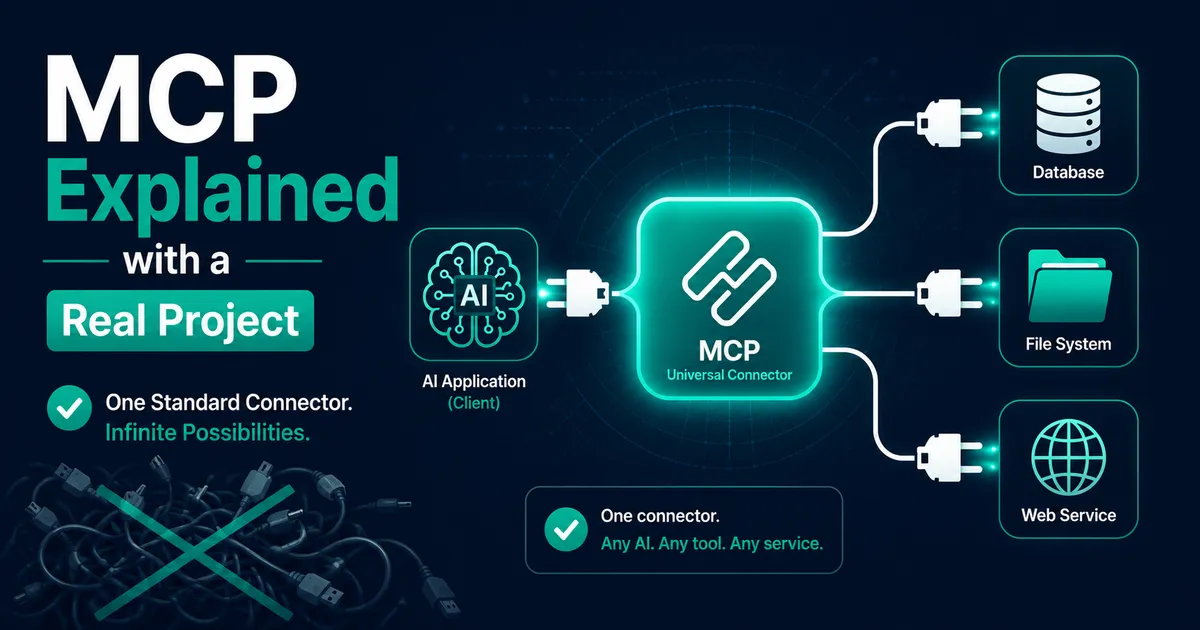
MCP (Model Context Protocol) Explained with a Real Project
MCP finally made sense when I built a real server for it. Here's my Model Context Protocol tutorial — Claude talking to my own database.
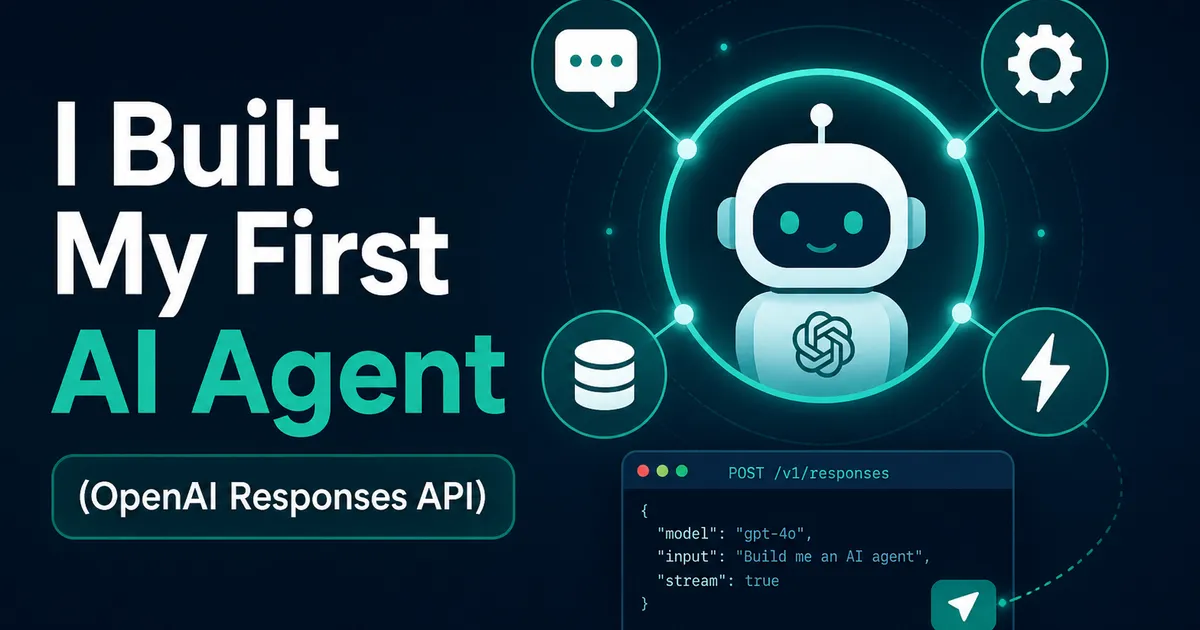
How I Built My First AI Agent Using OpenAI Responses API
I built a working AI agent on the OpenAI Responses API for my inventory app. The agent loop, tool calls, and the mistakes — full tutorial.
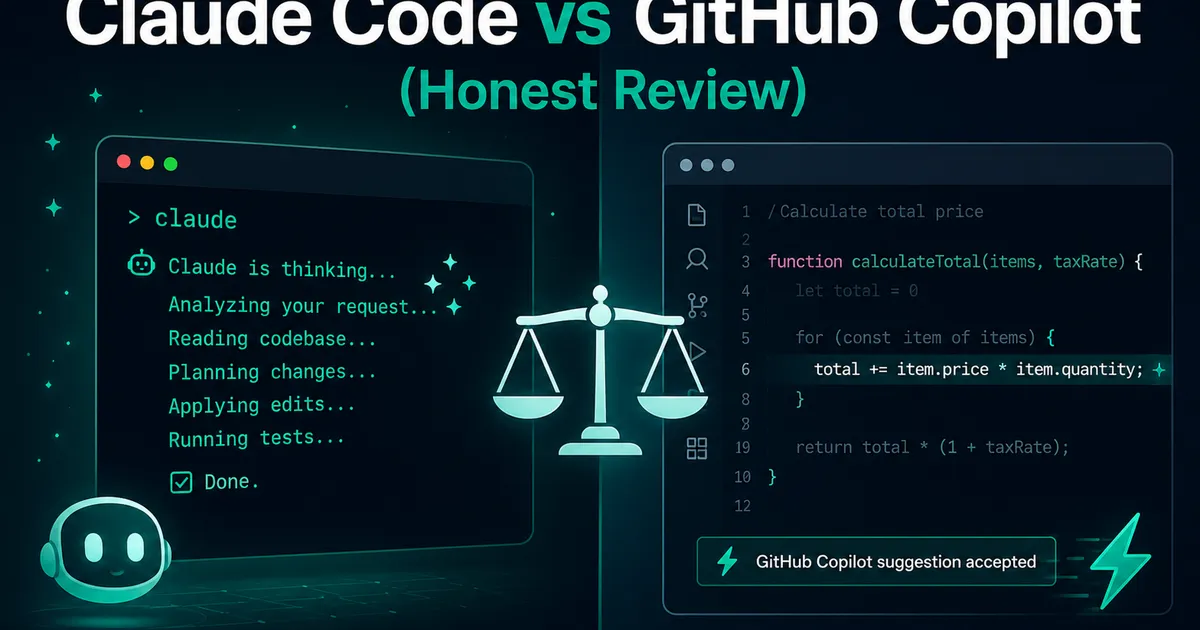
Claude Code vs GitHub Copilot: Real Developer Review
I used both daily for months. My honest Claude Code vs GitHub Copilot review — where each wins, real costs, and which one I'd keep.